

AI in procurement: Moving past the most common barriers
How to overcome data, integration, and ROI concerns and start seeing results fast.

Agentic AI is flooding inboxes and conference keynotes. It’s hard to separate what’s real from what’s just a slide in a vendor pitch deck, or inspiration for an expensive, drawn-out consulting engagement.
The gap between hypothetical and reality is closing. Many Zip customers are achieving measurable, quantifiable results all within weeks of deploying AI agents purpose-built for procurement. But questions still remain.
After more than 100 conversations with procurement leaders on this topic, here are the barriers I hear most often and how to move past them.
Barrier 1: Data quality and risk approval concerns
“Our data isn’t ready, and risk will never approve it.”
The assumption is that data needs to be pristine and proprietary before AI can add value. In past years, that was largely true.
The reality is that many AI use cases don’t require clean or sensitive data.
Research agents: A low-risk starting point
Research agents are one of the easiest places to start. They don't need clean master data and won’t expose sensitive information. We’ve built several templated Zip AI agents that can get started with variables as simple as a vendor name, product category, or supplier region, and achieve results like:
- Market intelligence without risk: Scan a supplier category and surface qualified vendors, certifications, ESG red flags, and benchmarks in minutes. This creates leverage in negotiations, uncovers innovation opportunities, and expands the pool of viable suppliers. All of it comes from public and third-party sources, so there is no need to expose internal data.
- Competitive context: Summarize what’s publicly known about a supplier’s financial health, reputation, competitors, or risk profile. These insights go beyond a Google search because they are structured for procurement decision-making.
- Filling data gaps: Even with incomplete supplier records, research agents can pull from public and third-party sources to supplement missing details.
Our team at Zip understands how procurement actually works, and prioritizes building agents that focus on scale and repeatability.
Your teams already perform this kind of research when they have time. The advantage is that AI agents can run it across all requests and flag the ones that deserve human attention.
In some cases, even minimal data makes a big difference. For example, our Duplicate Supplier Check Agent can work even without consistent user refreshes. Uploading a vendor list once a quarter is enough to identify potential duplicates, often more reliably than traditional methods.
Starting small with low-risk, high-value agents proves that AI can add measurable value today. In this case, these agents are about performing the grunt work that normally can’t be applied to every request because your team doesn’t have the time.
-min.png)
Barrier 2: AI training requirements and implementation timeline
“We’ll need to train our data, and that takes time, clean inputs, and expertise.”
This is one of the biggest misconceptions. Training custom models sounds like a multi-year project requiring perfect data and a team of AI experts.
The reality is that purpose-built procurement agents are already pre-trained for workflows like intake validation, contract reviews, RFP creation, and supplier checks. They can be deployed in weeks, not years.
This is exactly how OpenAI, Cribl, and Canva approached deployment. OpenAI's Intake Validation Agent went live in days and now handles data validation in seconds; work that used to take 15-20 minutes per request. Cribl's Price Negotiation Agent started benchmarking quotes against historical invoices immediately, capturing 12-15% savings per request.
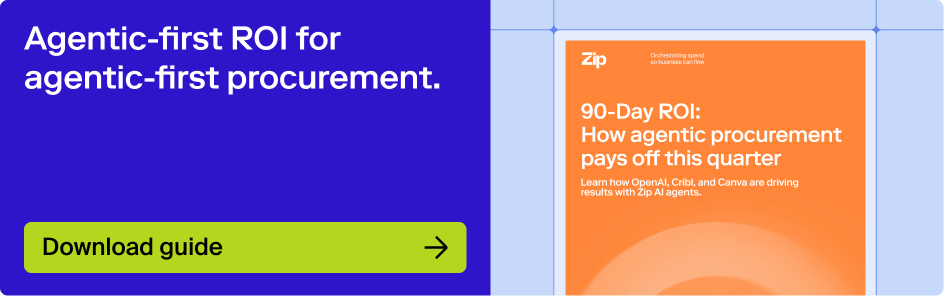
Our guide, ‘90-Day ROI: How agentic procurement pays off this quarter’, breaks down the specific agents each company deployed and the results they achieved.
Pre-built agents already have the foundational capabilities. What’s left is fine-tuning them to your policies, documents, and exceptions. You don’t start with a blank canvas. You start with proven agents and tailor them to your environment.
Barrier 3: Legacy system integration and AI readiness
“Our current systems aren’t AI-ready, so we’re limited in what can be done.”
It’s common to hear that legacy ERP, P2P, or CLM systems will hold back AI. The assumption is that nothing meaningful can happen until the stack is modernized.
The reality is that agents don’t require a perfect tech foundation. They can pull data from APIs, one-time CSV uploads, or public sources. Some legal agents can deliver value with nothing more than a single MSA or order form as input.
If an orchestration layer like Zip is in place, the impact is even greater because agents can embed directly into workflows across systems. But even without that, there are meaningful entry points. AI agents extend the value of your current stack rather than waiting on its replacement.
Barrier 4: Measuring AI ROI in procurement
“The ROI isn’t measurable.”
Most procurement teams are now firmly in the “prove it” phase. Every dollar spent has to be justified.
Here’s where AI creates real, measurable value:
- Closing compliance and governance gaps: Expand coverage without adding headcount or slowing cycle times.
- Increasing spend under management: Today, only high-risk or projects above $100,000 get procurement’s full attention. With agents, lower-value projects can still be monitored. A vendor below the spend threshold might be flagged as a duplicate, or a supplier could surface as unexpectedly risky. Those issues, previously invisible, now get surfaced.
- Reducing manual work: Agents perform checks automatically and only escalate exceptions. Think of them as specialized procurement interns: available at scale, consistent in execution, and never missing a step.
That combination speeds up cycle times, increases visibility, and improves control. ROI shows up in faster throughput, stronger compliance, and fewer issues slipping through the cracks.
Getting started with AI procurement agents
Yes, there is a maturity curve to unlocking the full value of AI in procurement. But there are already enough proven, low-friction entry points to justify moving forward.
At the very least, learn from companies already deploying enterprise-grade procurement agents.
Our new guide, ‘90-Day ROI: How agentic procurement pays off this quarter,’ featuring OpenAI, Cribl, and Canva includes the ROI framework behind their results, and a clear picture of what's achievable within a single quarter.





.webp)




AI procurement orchestration, from intake to pay
Enter your business email to keep reading
