
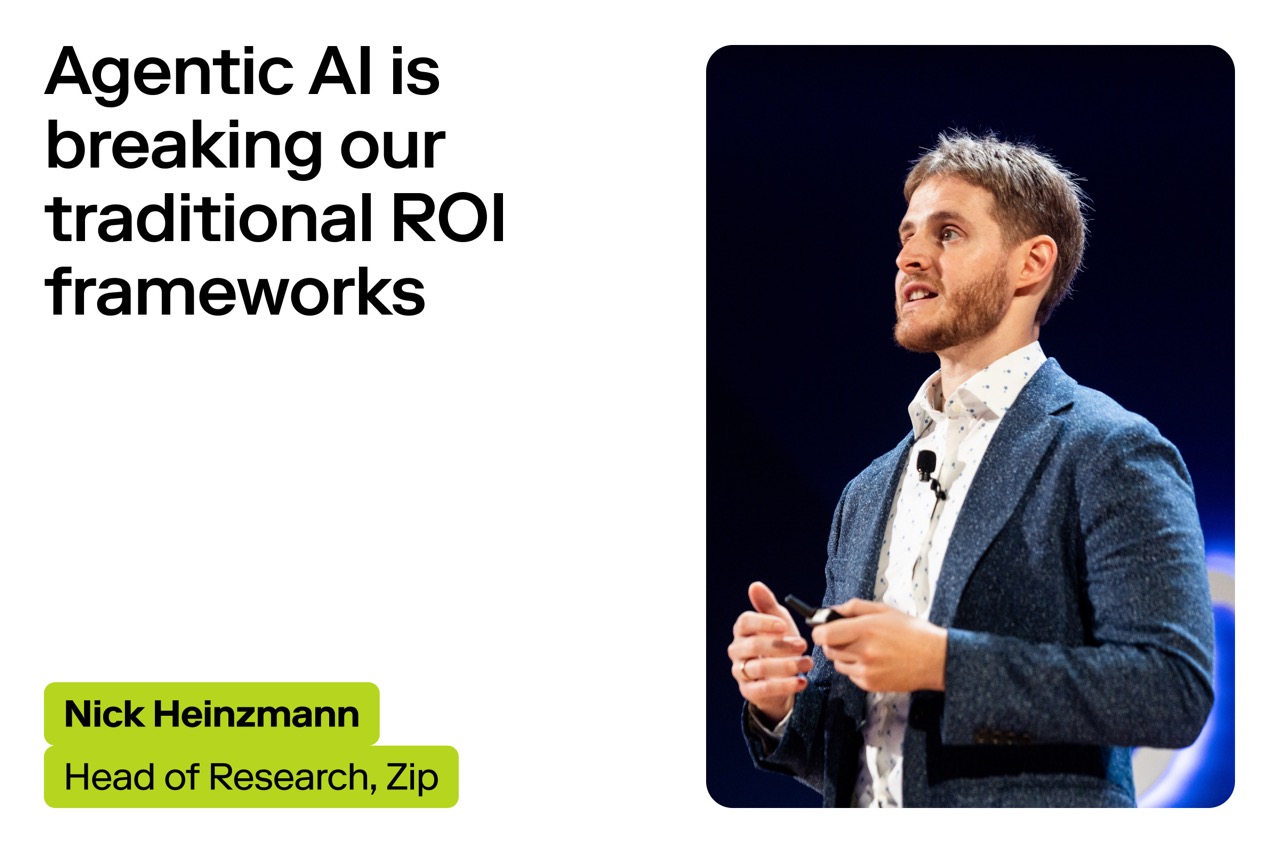
Agentic AI is breaking our traditional ROI frameworks
Everest Group’s new report asks us to consider the value beyond cost-savings.

There's something unique about what's happening with AI right now, and I’m seeing it everywhere.
When we look at AI today, we're looking at a true step-change that is going to require us to completely rethink how we measure and define value.
Why rules-based procurement automation hit its limit
For years, procurement has attempted micro-automation across procurement processes. The approach was always the same: rigid, linear, rules-based workflows that required everything to be structured just right before they could function. These robotic approaches to automation worked technically, but they had serious limitations.
Once we got the basics of the automation working, we quickly hit diminishing returns. It was like getting blood from a stone. The workflows were brittle, the setup was complex, and improvements were hard-won.
Linear, rules-based automation has met its limit.
What makes agentic AI different from traditional automation
AI agents represent a step-change versus incremental improvement to past automation approaches, and there are two key reasons why.
First is the breaking of the UI barrier. Instead of having to structure everything perfectly and rigidly set up all the workflows, the natural language understanding of generative AI allows us to converse with our automations and computers for the first time in a truly natural way.
Second is the ability to work fluidly with unstructured data. This combination gives us a much more fluid approach to how we build and deploy automation.
Because of these capabilities, AI more closely mirrors and "works" the way humans do, and it improves as we keep working with it. This is fundamentally different from enabling robotic approaches that required rigid structuring and delivered diminishing returns over time. As these implementations move from proof of concept to production, we're seeing that they can continue to improve themselves over time.
From ‘Systems of Record’ to AI-powered ‘Systems of Execution’
If you think about it, agents force a profound shift in how we operate and how we define value delivery.
Instead of delivering an automation that's just a workflow operating the same way every time, we have something that's more similar to how a person works. The system is no longer just a tool that you apply or a record that you keep but actually becomes something that acts itself.
As Everest Group discusses in their new report, this represents a movement from ‘systems of record’ or systems of engagement to ‘systems of execution’ or systems of action. This shift to systems of execution is really the difference in how we need to look at ROI, and it's why we have to measure and define success so differently.
Rethinking procurement ROI for agentic AI
That's what I really appreciate about how Everest approaches this topic in their research. In order to get ROI measurement correct, we need to update our assumptions about how not only technology works, but also how we measure outcomes.
It's not just the normal cost savings or cycle time reductions, though those are certainly part of it. It's also considering:
- How does this help us become smarter or get to market faster?
- How does it enable continuous risk sensing so we can be more proactive than before?
- How do we measure things like elevating the trust and brand of procurement because it's more interactive and able to execute on its own?
These are all questions that are still open. As Everest says in the paper, it's an iterative process, but one where we have to redefine how we look at ROI because a lot of the next-level improvements come from reimagining what can be done in procurement in the first place.
A framework for human-AI collaboration in procurement
This is the fundamental shift. We're now comparing ROI against how humans operate, rather than how we make a human more efficient with a tool. That requires a complete reimagining of ROI.
It really means comparing different modes of work and thinking through:
- Could a human do this better with AI assistance?
- Could AI do this better on its own?
- Or is this something that a human should do independently?
Thinking through those three different modes, and understanding what gets the best results in each, is the definition of reimagining procurement.
How to measure AI value beyond cost savings
The shift to AI agents requires fundamental rethinking of how value gets created and measured in procurement operations.
The organizations that will succeed are those that stop trying to fit AI into old ROI frameworks and instead consider what now becomes possible when our systems can act, learn, and improve on their own.
Want to dive deeper into the ROI of AI agents? Download the full Everest Group report to see their complete framework for measuring and capturing value from AI in procurement.
%20Large.jpeg)







%20Large.jpeg)


.webp)


AI procurement orchestration, from intake to pay
Enter your business email to keep reading
