
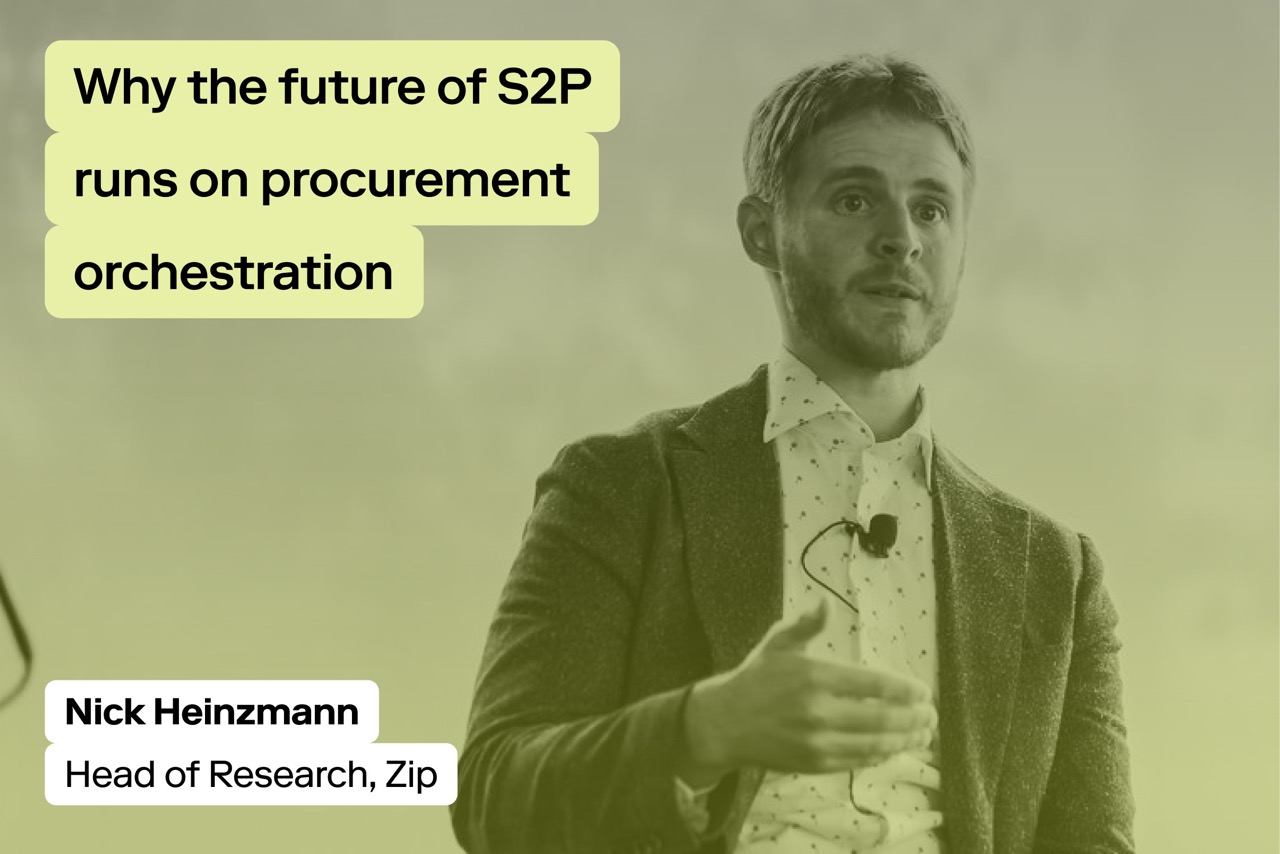
Why the future of S2P runs on procurement orchestration
Here’s how procurement orchestration expanded from intake to full source-to-pay.

When Zip first introduced the concept of procurement orchestration to market, it was designed to solve a specific problem: the gap between how enterprises actually buy and how their systems were built to support them. It unified people, workflows, and systems through a single front door.
But as the category matured, it became clear that orchestration alone wasn't enough.
Our customers pushed us further, telling us that they wanted more out of Zip than just our industry-leading intake, but to orchestrate the entire source-to-pay process. What originally started as a better way to manage intake workflows has now expanded into a next-generation platform that encompasses the full procurement lifecycle, from intake to pay.
We believe this is why Gartner has recognized Zip as a Visionary in the Gartner® Magic Quadrant™ for Source-to-Pay Suites, the only procurement orchestration platform in the analysis. Orchestration has now expanded to include S2P, and it’s our belief that this is where leading organizations will run their procurement processes going forward.
Source-to-pay was built for another time
To understand why orchestration has expanded in this direction, it helps to understand why the original S2P paradigm has reached its limits.
Source-to-pay was a philosophy built for yesterday’s procurement function: an era of ‘standardization.’ Consultants and technology providers sold a vision of a linear, digitized process that everyone would follow. And it worked, for a time.
Source-to-pay was not necessarily a mistake. It's just not an approach that is built to get us where we need to go.
S2P was designed with procurement and finance as the power users. It expected top-down compliance. It assumed a linear process and a standardized, goods-and-materials-focused world, in effect something easily cataloged and managed.
Procurement today is very different.
S2P was also built for an era of departmental transformation: procurement transformation, finance transformation, business functions operating in silos that were rarely connected. That made sense when there wasn't much software to integrate, as companies weren't fully digitized 20 or 30 years ago.
But now there's been a proliferation of software and a general digitization of business. Even ERP, which was supposed to control the whole enterprise, has unbundled into specialized systems: CRM, S2P, human capital, payroll, and more.
A more complex world demands a broader platform
Today's enterprises have more technology, more spend, more stakeholders, and more external complexity than ever before. The old approach simply doesn't scale. Research from The Hackett Group reveals that only 19% of organizations have purposefully designed their spend orchestration model across the full scope of spend, a massive opportunity for strategic transformation.
This is exactly why procurement orchestration has expanded.
We have more systems and more departments that need to be connected, unified in some coherent way. The procurement process doesn't run in the linear fashion consultants described for 20 years. It's dynamic, changing and adapting based on what's being bought, who's involved, and what policies apply. As our State of Spend research found, 70% of leaders now prefer a hybrid, orchestrated best-of-breed approach over monolithic suites.
And as AI transforms how software and businesses operate, everyone needs a new supporting structure to survive in that competitive environment.
The full scope of orchestration spans intake to pay
Procurement orchestration had to expand because the market demanded it.
Running procurement orchestration from intake to pay or, running source-to-pay on a procurement orchestration platform, is the end-state we at Zip have been building toward. This isn't something you just layer on top of existing systems but rather the underlying infrastructure for procurement transformation in the 2020s and beyond.
We believe this is the foundation for the next eradication of procurement.
AI will only accelerate this. You will deploy and run your agents on an orchestration platform, both from the orchestration provider and from partners who build agents on top of it. Without the structured, well-governed workflows that orchestration provides, AI simply cannot operate effectively. The organizations that build this foundation now will be the ones that unlock true fully autonomous procurement in the future.
This is the beginning of a generational shift
To thrive in this new, more volatile, more complex, more technically advanced world, you need the right foundational operating system.
Ten or fifteen years ago, the pitch was all about the cloud: get digitized, move off on-prem. We've completed what I would call a “super-cycle” in procurement over the past 20 to 30 years. We built the original S2P platforms on-prem, then moved them to the cloud. But the limitations became apparent, especially in the 2020s, and that's why orchestration platforms emerged.
They weren't in their complete form until recently. Zip founded this category and has led its evolution to the fully formed product: a procurement orchestration platform where the end state is running the entire source-to-pay process, intake to pay, end to end.
You can see this acknowledged across the market. Legacy platforms are replatforming. Cloud-era suites are trying to build and rebrand as orchestration. They recognize this is the future.
We believe Gartner is calling Zip as a Visionary because orchestration, with full S2P breadth, is where the market is heading.
Zip is still in the middle of completing that vision, but our prediction is that companies will increasingly favor this approach. We'll see more advanced capabilities in orchestration, AI for procurement, and purpose-built agents that depend on this new foundation.
The future of procurement comes down to a choice: stay with legacy systems riddled with tech debt, or modernize to a platform built for what comes next.
We believe Gartner is calling this out for the first time. It certainly won't be the last.
For more information about AI-enabled procurement orchestration from Zip, request a demo today.





%20Large.jpeg)


.webp)


AI procurement orchestration, from intake to pay
Enter your business email to keep reading
