
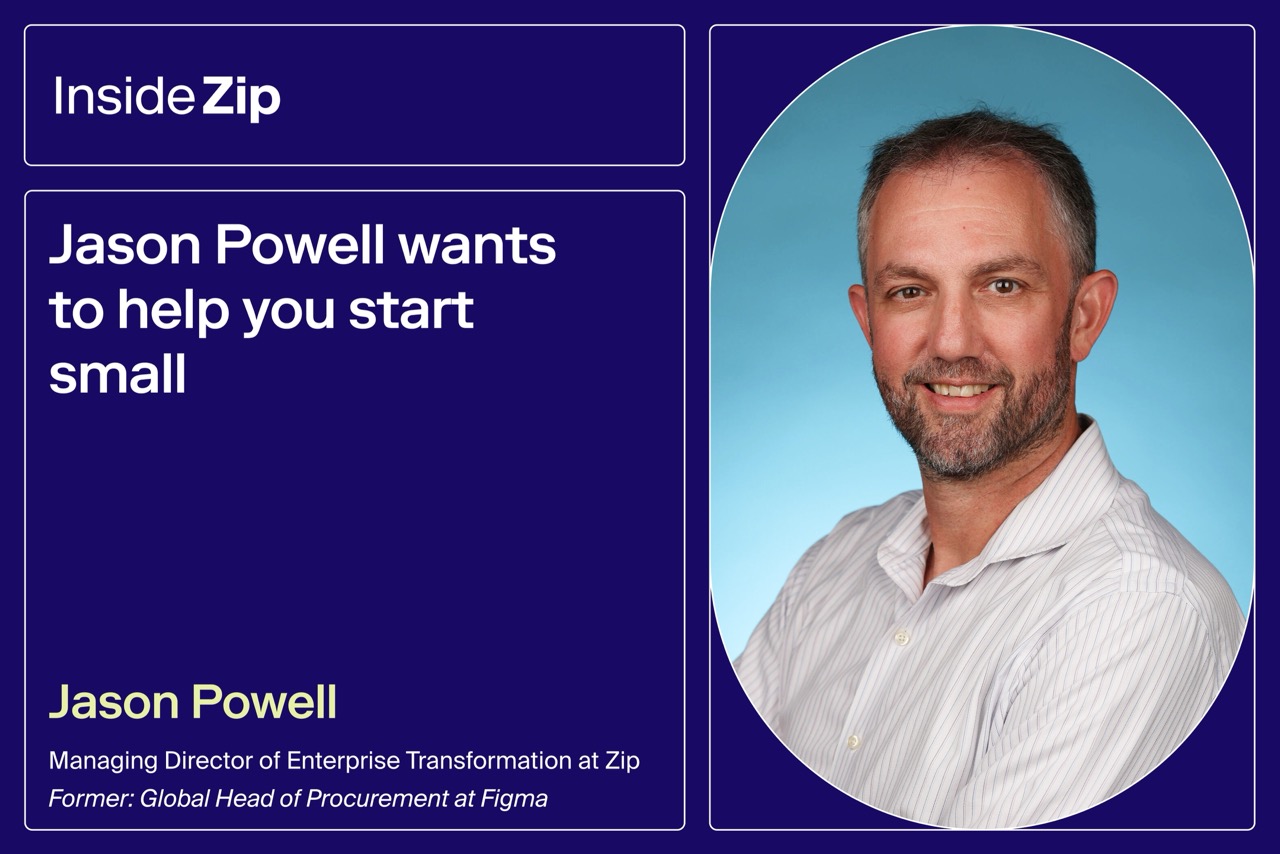
Inside Zip: Jason Powell wants to help you start small
From Figma to Zip, Jason shares his advice for procurement leaders in 2026.

At Zip, we know that procurement transformation isn't achieved through technology alone. It requires deep expertise and a commitment to guiding each customer's unique path to success.
That's why we launched the Enterprise Transformation Office: a dedicated team of former Fortune 500 procurement leaders working directly with customers to drive large-scale transformation. Zip's ETO is comprised of leading practitioners who've sat in the seat, managed billions in spend, and led the kind of change most companies only talk about.
In this series, we're sitting down with each member of the ETO to learn how they got into procurement, what brought them to Zip, and what advice they have for enterprises navigating the AI era.
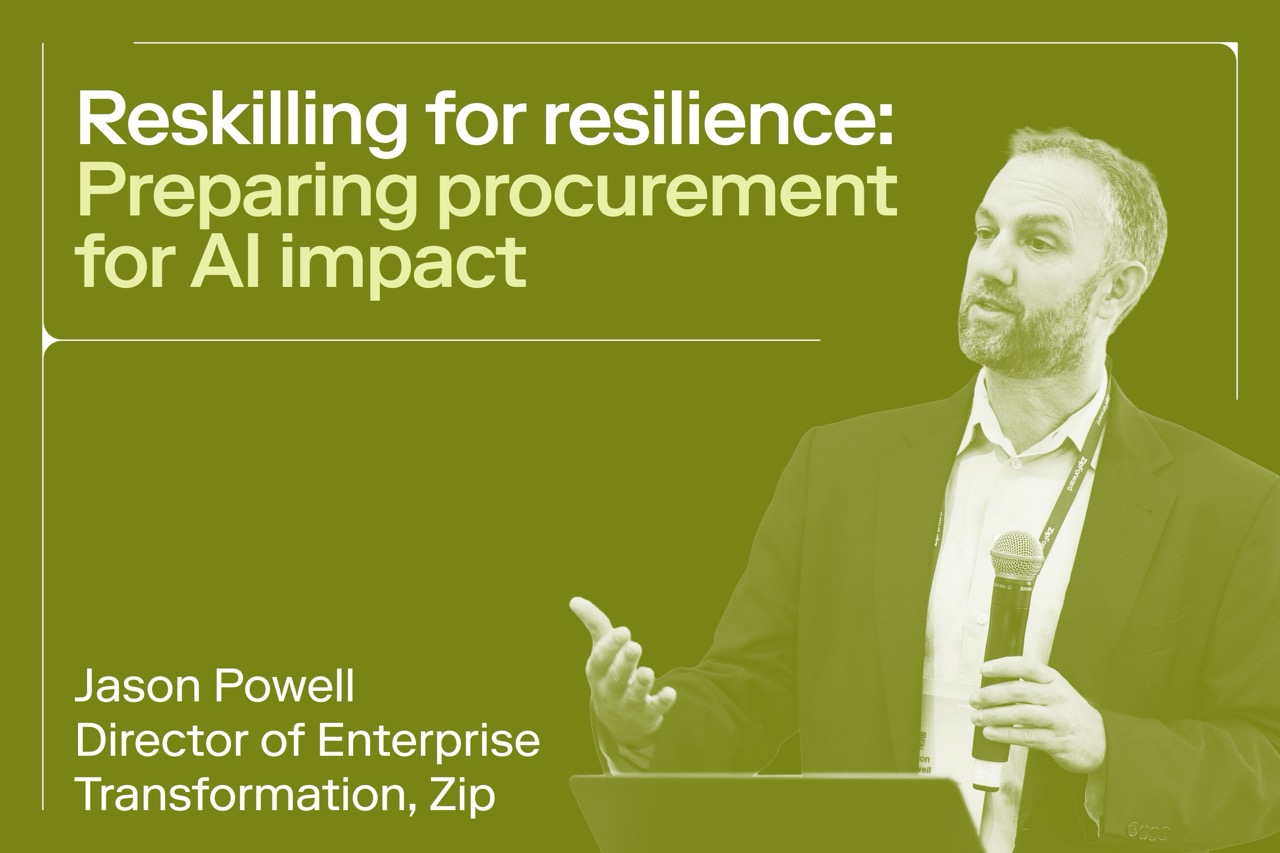
Meet Jason Powell
What brought you into the world of procurement?
I fell into procurement! Prior to this phase of my career, I spent years in various accounting, finance, and corporate strategy roles. At one point, the company I was working for was going to get audited in six months by their parent company for compliance to Swiss laws related to SOX compliance. As a special projects finance staff member, I was assigned to investigate our current process and make any recommendations for changes to ensure compliance.
At this stage in my career, I was being limited by a lack of management experience, and it was difficult to get promotions in a historically flat finance org. That being the case, once I did my analysis and put together recommendations including a new org chart. Of course, I went ahead and added my name to the top of the procurement org.
Having just spent the last several months studying the space and our process, I was lucky to have been provided the opportunity to lead this function. This was my first time working in procurement or having any direct reports. It was never my intention to work in procurement, but it was a means to get management experience.
Years later, I can firmly say that this was one of the best decisions I have made. Not only is procurement a good fit with my skillset and personality, but my experience in finance and accounting prior to this has been invaluable.
What inspired you to join Zip?
Having worked in this space for many years, I have seen many different types of software. While some are better than others they typically are all fundamentally fairly similar, just with a different UI. As a practitioner, I was very much aware of the challenges not only of initial implementation but ongoing maintenance and enhancements.
One thing that had always seemed clear was that traditional procurement platforms appeared to have been designed in two ways. The first was based on what the "approvers" needed. The second was based on a centralized purchasing function where users would be working inside the platform on a regular basis. My experience showed this just wasn't a true picture of how many businesses operated, or how they are operating today. Many companies, particularly smaller ones, have very decentralized purchasing with many more infrequent users.
Zip was the first platform I saw that was designed with the requestor in mind and takes into account infrequent users by making the process so simple. That was the first thing that made me want to join.
The second thing was the people. Having been a customer for two years, I was able to not only observe Zip during the sales cycle but watch how they supported our team, valued our feedback on the product, and took rapid action to address gaps. This was also unique from my perspective, as I was accustomed to yelling into a vast canyon and only hearing my own echo.
These two things inspired me to join the team.
What was your reaction the first time you encountered Zip?
My first reaction was that it had a modern user interface. My second reaction was that the tool must not have very many capabilities, as the UI was so much cleaner than other systems I was used to.
It took some time for me to appreciate the level of complexity the tool could support while still keeping the experience for the end user very simple. That was exactly what I was looking for.
What are some of the problems in procurement you believe Zip helps solve?
I could probably write a novel on this, but I'll share a few points. The most important things that Zip helps solve for are engagement, visibility, and flexibility.
As far as engagement: the most important aspect of any intake-to-pay tool is ensuring all of the company's spend is flowing through the tool. If there is leakage, you will have incomplete reporting or compliance gaps. By focusing on a simple UI and hiding complexity from end users, Zip helps encourage a higher level of engagement.
Visibility can take on several flavors. You start with visibility for the requestors. They can see exactly where their request stands, what remains, and with whom. For procurement, this visibility takes many forms, but one of the most useful is related to contract renewals and having the ability to schedule reminders to ensure maximum leverage during all negotiations.
Finally, flexibility relates to how you manage the intake-to-pay process over time. One of the most impactful lessons I have learned running procurement functions is that in many cases, you don't know what you don't know.
Even after a full rollout of Zip, I have consistently found new or unidentified use cases that don't work well with my standard process. Having the ability to rapidly iterate based on changing business circumstances or use cases is critical to addressing business needs. Zip is uniquely capable of enabling teams to rapidly iterate even without formal IT or vendor resources being required.
What are you most excited about in the next era of procurement?
AI. I think we are at the very beginning of seeing where AI can play a role in the procurement process. At the same time, I think we are also going to see some degree of back and forth when it comes to AI.
The example I would use is when OCR technology came out. At the time, this was sold as the way to fully automate P2P. It was said that with OCR, when an invoice arrived, as long as there was a matching PO, then the invoice could be fully automated. The reality turned out to be different. OCR made enough mistakes that companies added a review step to confirm the entries. So while there was a push to adopt OCR, there was a bit of a backlash in that humans still needed to be in the loop.
I think we are at a similar stage with AI. I think we are going to see three steps forward and one step back in some cases. I'm really excited to see how this plays out and where it settles.
The marriage of technology and humans is what the next era of procurement is all about, and I don't think we know yet exactly where this will land. That’s what makes it exciting.
What advice can you give for those seeking digital transformation in 2026?
Two things.
First, delaying a transformation project only increases the pain. It reminds me of when I was deciding to have my first child. I kept thinking there was some magical time when all my other commitments would decrease, my job would be easier, I would have plenty of extra money, and I was 100% prepared. Every month I waited made it more clear that this dream just wasn't a reality.
I often hear people say now is just not the right time and we will have more bandwidth to take on a project like this next year. Will you? I have yet to work in a role where I ran out of things to do. If anything, it was more a discussion of which things I wouldn't have time to address and prioritizing. Given that one of the main benefits of a platform like Zip is efficiency and time savings, the faster you can deploy, the more time will be made available to tackle all the other priorities.
The second piece of advice is related to two common sayings: "don't boil the ocean" and "don't let perfect be the enemy of good."
The main point here is that many often feel like the reason they aren't ready for a transformation is it just seems too large. It doesn't have to be. Start small.
Choose one area of spend or one use case and solve for that. Each one you solve for will free up more time and allow you to pursue future iterations.
Also, as mentioned previously, in many cases you won't know all the challenges or use cases within your current process until you stand up a new standardized tool and process.
By solving for the 80% of purchases that would work well through a standard process, you can help your stakeholders identify and communicate back those use cases that won't work as well and may require a custom solution.
Ready to work with us?
It's time to find out how Zip can transform your procurement processes. Connect with our expert team to learn more.
%20Large.jpeg)







%20Large.jpeg)



.webp)


AI procurement orchestration, from intake to pay
Enter your business email to keep reading
