
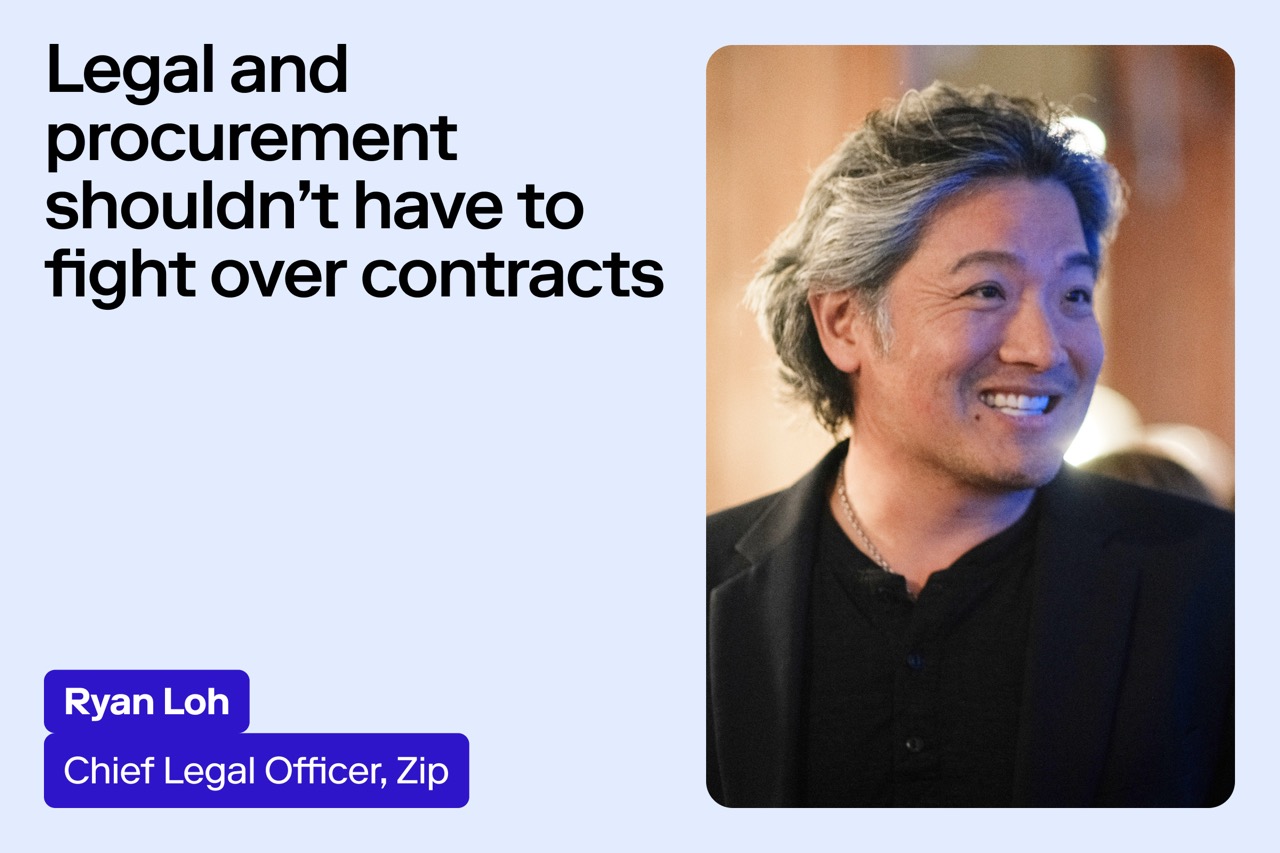
Legal and procurement shouldn’t have to fight over contracts
A CLO's framework for who should have to handle what, and why.

As the Chief Legal Officer at Zip my job is to protect the company, manage our risk, and keep the business moving. Diverse workstreams including commercial contracts, employment matters, corporate governance, regulatory compliance, and the occasional fire drill all runs through my team.
This is all important work, which is exactly why it matters where legal time actually gets spent. It shouldn’t be controversial to say that not every contract that crosses my desk is equally worth my attention. Some of what I do is the reason companies hire in-house lawyers in the first place. There are moments that require real judgment calls, real negotiation, and real expertise. But some of it involves contracts that have to be reviewed because nobody else is going to do it.
Every in-house lawyer I know has a version of this problem. It's the dirty secret of the job.
Why the legal and procurement relationship is top of mind for me
Before Zip, I was CLO at Brex. Before that, I was general counsel and head of legal at other tech companies. I've built legal functions from scratch, inherited mature ones, and worked alongside procurement teams of every size and maturity level. I've sat across the table from procurement leaders as a startup GC with no budget, and I've sat next to them as a mature company's CLO with a real stack of tools.
Now I'm the CLO at an AI procurement software company, which means the relationship between legal and procurement is, in addition to being something I manage, something I think about constantly as part of what we're building.
And across every one of those seats, I see a consistent problem bubble up time and time again.
The hamburger contract: low-value contract review is eating legal’s time
I've been calling them ‘hamburger contracts’ for years. The name started as a joke and stuck because it’s actually accurate.
A hamburger contract is the urgent catering order for the $4,000 company dinner in New York next week. Or maybe the hotel block for the offsite. It's the monitor purchase, or the engagement letter for the audit firm. It's the three-page SaaS renewal with terms that are functionally identical to the last fifty three-page SaaS renewals. It's any contract where legal's actual value-add is "nothing weird in here," a sentence that does not require a JD to produce.
And it's most of what lands on a legal team's plate from procurement. Not the big partnership deals or the strategic supplier agreements. Not the long tail of spend contracts where legal review is a formality that still takes real hours, and where "urgent" is the default priority because somebody on the business side already told a vendor the deal was happening.
If you're an in-house lawyer reading this, you already know exactly what I mean. You probably have one of these in your queue right now.
Why legal and procurement alignment never gets fixed
Boiled down, the issue is that legal and procurement have been talking past each other on this for years.
Legal teams fight hard for their tooling. If you've ever built a legal function from the ground up, you know what it takes to get budget approved for a real CLM, to roll out DocuSign properly, to get the stack working. By the time it does work, you are (reasonably!) protective of it. So when procurement shows up saying "we have a new platform, let us handle your contracts," the answer is usually some version of "thanks, we'll stick with what we built."
I'll say the quiet part out loud here, which is that lawyers don't buy legal tech from procurement. I wouldn't buy a CLM from my deal desk, and I don't expect my peers to either. Don’t accuse me of being a snob here; this is a reasonable instinct about who should own the tools that govern legal work.
But the result is a standoff. Procurement has a workflow problem, while legal has a bandwidth problem. The hamburger contracts keep flowing. Both sides stay frustrated because neither side's tooling actually solves it. Both sides are approaching it from the seat of their own domain.
Which contracts actually need legal review?
I don’t think the solution is to give legal a new tool. I think there's a specific, well-defined slice of contracts where it makes sense to let procurement systematically handle them, with enough guardrails that legal can trust the output without individual review across the board.
Because underneath the turf dynamics, legal and procurement actually share the same fundamentals.
Both functions exist to manage risk, and need internal controls that hold up to an audit. Both care about access controls, visibility, and a clean paper trail. If a system genuinely satisfies those fundamentals for a defined category of contracts, the question of whose tool it is matters a lot less than whether the controls are real.
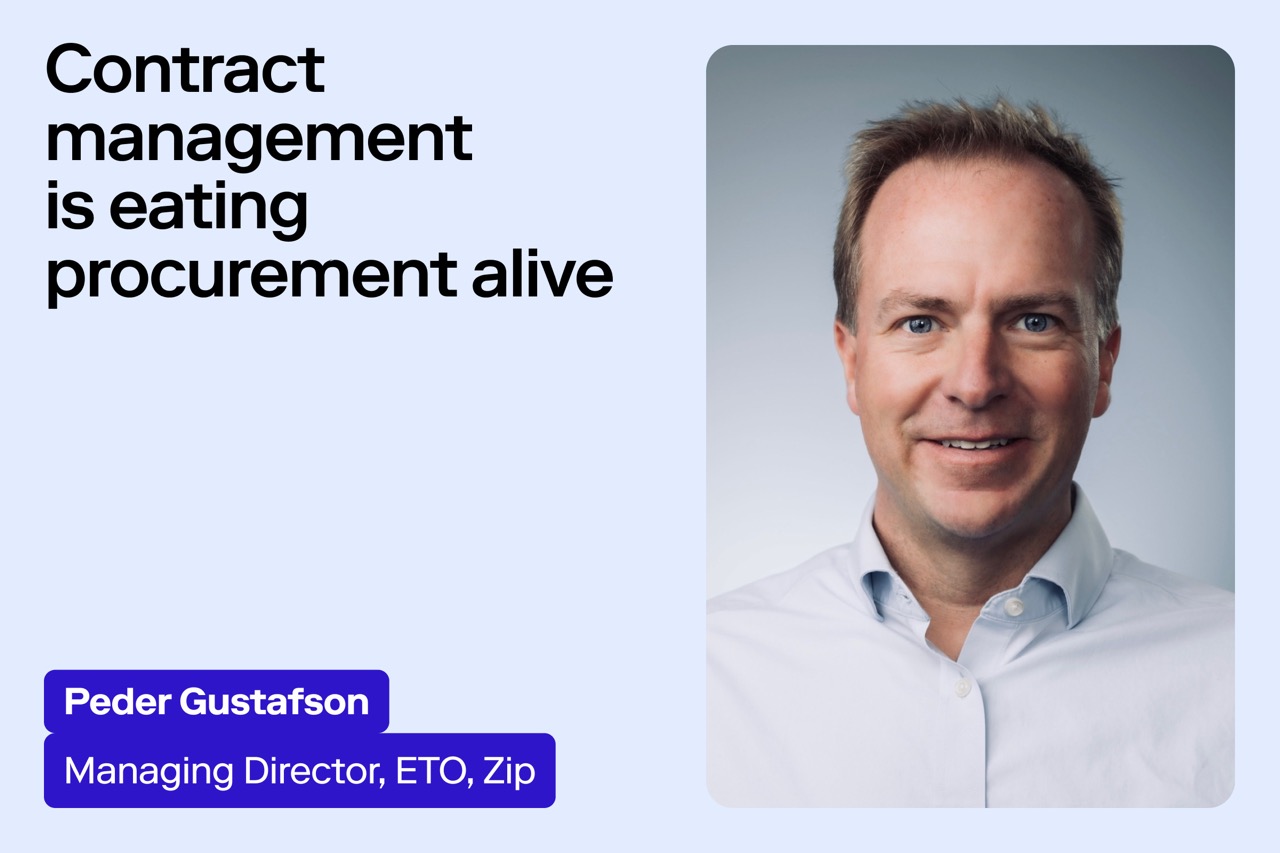
My colleague Peder Gustafson, a former CPO, makes a related argument about how contract management is eating procurement teams alive, and the solution requires both functions to rethink who owns what.
What AI contract review needs to get right before legal will trust it
For me to sign off on letting a category of contracts flow through a procurement platform without my team's eyes on every one, I need a few things to be true.
The playbook has to be mine. If the system is auto-suggesting redlines, it has to be redlining against my legal team's pre-approved positions, not a generic template or a best-practices library. Legal owns the rules, and the AI enforces them.
The triage has to be conservative. Standard, low-risk agreements can move through automatically, but anything that hits a risk threshold, like unusual liability terms, data privacy exposure, non-standard termination, gets escalated to a human reviewer with the context already attached. When in doubt, route up.
The risk detection has to be visible. I don't want to find out after the fact that an agent missed something. Instead, I want a risk summary on every contract that tells me what it flagged, what it didn't, and why.
And the obligations have to survive signature. Most contract problems don't happen at signing but eighteen months later, when the negotiated pricing quietly diverges from what's actually being paid, or when the auto-renewal clock runs out on a vendor nobody remembers owning. If the system can't track that, it hasn't actually solved the problem.
These are the controls we built into Zip's AI Contract Orchestration. Not because they make a good feature list but because they're the minimum bar I'd need to meet as a CLO before I'd let a category of contracts go.
This is not a CLM replacement
I want to be direct about the scope, because I think a lot of legal tech conversations go sideways when the scope is fuzzy.
This is not a CLM replacement. If you have Ironclad and it's working for your sales contracts and your partnerships and your strategic agreements, keep it. I'm not here to tell you to rip it out.
This is also not the legal-native AI tooling built for how lawyers actually work on complex deals. That's a different product category, and I use those tools too.
This is specifically about the supplier contract slice that sits between procurement and legal. It's the slice where most of the friction in both jobs lives, and the slice where the hamburger contracts pile up.
The payoff: faster cycle times and fewer outside counsel hours
At Zip, we use our own product. Our "no legal review" policy for qualifying contracts is real, and it exists because the controls are real. I don't review hotel blocks anymore. I don't review the catering orders. When an audit engagement letter comes in, it routes through the right workflow without landing in my queue.
Early customers are seeing the same pattern. Bandwidth has cut NDA turnaround time by 60 percent.
Across our early AI Contract Orchestration customers, contract cycle times are down 51 percent and outside counsel hours are down 50 percent. Those numbers are the direct result of legal teams letting a specific category of work move through a procurement workflow they trust.
The goal was never to make legal teams fall in love with a procurement tool—I’ll believe that when I see it.
The goal instead was to get a specific category of work off your plate so you can spend your time on the contracts that are actually worth your attention.
Let procurement have the hamburger contracts. You have better things to do.
Request a demo of AI Contract Orchestration, and let me know what you think!










%20Large.jpeg)



.webp)


AI procurement orchestration, from intake to pay
Enter your business email to keep reading
