
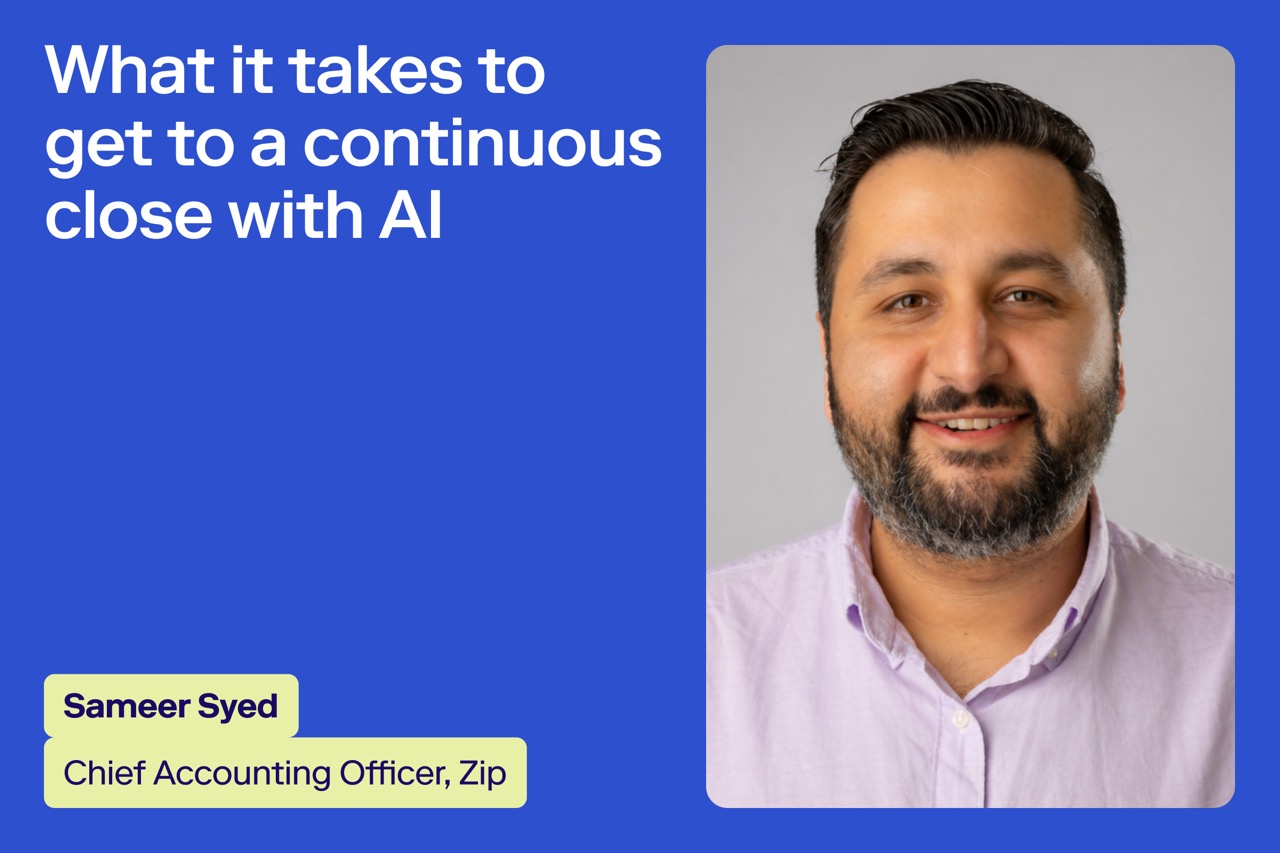
What it takes to get to a continuous close with AI
The three moves separating finance teams running a zero-day close from the rest.
.jpg)
A hot topic that keeps coming up is this idea of ‘continuous close,’ or ‘zero-day close’. It’s aspirational today, and to some it may seem unrealistic, but it is coming. It's a matter of when we get to this ideal state, not if.
What I want to do here is take a step back and explain how companies might actually get there.
I'm a sitting CAO at Zip running this play on my own team. The difference I see between the orgs that will pull this off in the next few years and the ones who'll still be running month-end close fire drills isn't about who bought which tool. It comes down to three things moving together: the right people, technology built on unified data, and controls designed for agents and humans working together in full alignment.
If any of these are missing, the whole thing stalls. Here's how I'm thinking about each.
1. Accountants who think and operate on first principles
The truth is that we’re now seeing a world where fewer accountants are entering the workforce every year. To be blunt, budgets for AI are growing while headcount budgets are not—they might even be decreasing at this point. The math means the people we do hire from here on out matter more than ever.
And the role itself is changing. I'm not hiring people to prepare schedules and code invoices anymore; what I'm hiring for is people who can look at a process and ask, "what's the core problem, and can AI resolve it?" That's the engineering mindset based on first principles applied to accounting.
This means we’re looking for accountants who are builders.
People who know that critical thinking and judgement are more important than ever. We need people who can prompt, deploy, evaluate, and govern agents that can act on their behalf, rather than just resorting to the same old workflows dependent on humans to operate day-to-day. We need people who want to build, rather than just maintain.
The accountants who'll thrive in this environment are the ones who get entrenched within the business, drive value into commercial decisions, and treat AI as a capability they design with rather than just another tool to learn. That's a different hiring profile and career ladder, and a different definition of what "good" looks like in finance. The orgs that figure this out before they need to are the ones that won't be scrambling for talent in a few years.
2. Technology built on unified data
Most legacy finance technology can't get you to a continuous close because it was never designed to. It batches and moves data in handoffs between systems that don't talk to each other or share the complete needed information.
The issue now becomes whether the AI has enough upstream context to resolve exceptions before they hit the close, or whether it's pattern-matching on the invoice alone and flagging the rest back to a human. What's needed is accuracy and completeness; both are required to earn trust.
Continuous close requires that every agent involved reads from the same context across every element of the process. When that context is fragmented across disconnected systems, agents either guess or hand the work back. Either way, you're not closing continuously, you’re just running slightly faster with a chatbot on top.
This is the part of the problem I care about most at Zip, and it's why I'm bullish on what we've built with AI Automation for Procure-to-Pay.
Zip is the first AI-native platform to orchestrate the entire P2P lifecycle toward the goal of a continuous close. Every agent in the suite, from invoice coding to payment risk to capitalization, operates on the same unified data, because Zip already orchestrates the upstream P2P process. The context is there before the invoice arrives, which is what makes automation accurate at the edges and what makes the output defensible at audit.
If your tools can't share context you can stack as many agents on top as you want, but you'll still be scrambling at month-end.
3. Controls built for agents, not just for humans
Standard SOX controls assume humans are doing the work and rely on systems to generate key reports. The framework is built around segregation of duties, change management, access controls, and reviews performed throughout a cycle by people.
When agents start doing real work, that framework needs a layer added on top of it: how do you govern agent deployment, validate agent output, manage version control and change management, all while maintaining an audit trail your external auditor will accept and keeping humans in the loop for oversight?
If you can't reperform it, you can't sign off on it. And if you have to reperform every agent's work manually, you've eliminated the point of having the agent.
The frontier I'm watching is a world in which agents monitor agents. In practice, this means a controls layer where one agent's job is to audit another agent's output against source data and surface anomalies before they age into the close. Zip is early on this. High observability and auditability is where the controls conversation is heading: a governance layer where agents monitor agents and humans maintain complete oversight through a scalable governance model.
The orgs that get a head start on building this layer are the ones who'll trust a continuous close enough to actually rely on it at scale.
The advantage compounds with AI Automation for P2P
Most accounting orgs are going to spend the next few years figuring out each of these pieces, and that's fine.
The organizations that figure this out first will have a structural advantage that's hard to replicate. They'll run leaner teams, attract higher-caliber talent, generate signals in real-time within the period, face fewer surprises at month-end, and maintain a governance posture that satisfies both internal management and external auditors.
AI Automation for P2P is what makes that advantage possible to build on, because the unified data and the agent coordination are already there. Your team gets to focus on the work that compounds like the talent decisions, the controls layer, and the strategic shift in how accounting operates.
The teams I talk to who are furthest along on this are the ones who have these pieces moving together. That's the play. The guide we put together walks through the procure-to-pay lifecycle in detail and what building toward continuous close looks like at every step.

%20Large%202.jpeg)
%20Large.jpeg)
.webp)




.avif)

AI procurement orchestration, from intake to pay
Enter your business email to keep reading
