
%20Large%202.jpeg)
Forrester quantifies the business case for procurement orchestration
Zip’s Head of Business Value business shares the indicators to pay attention to.

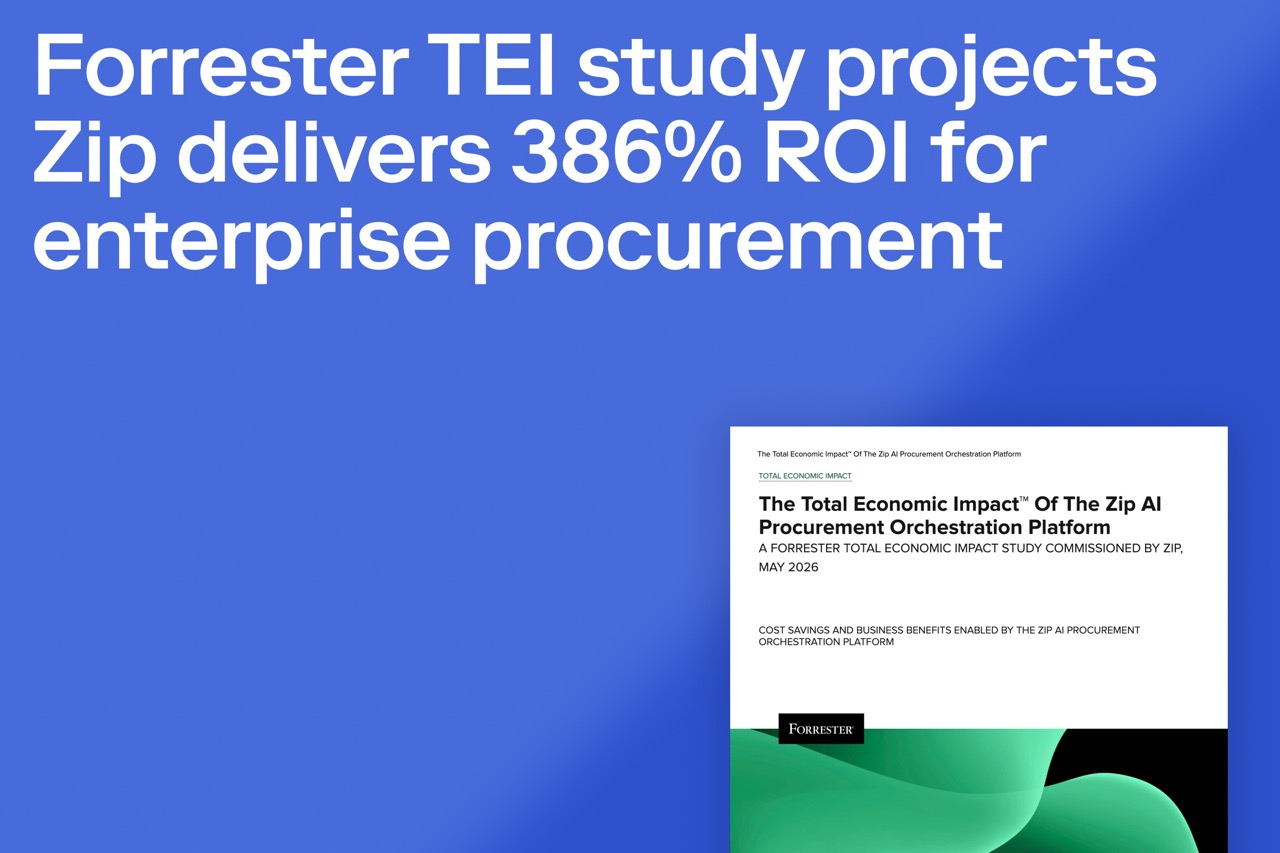
Zip just commissioned Forrester Consulting to conduct a Total Economic Impact™ study of Zip that tells the complete strategic business value story modern enterprises want to hear.
We believe it demonstrates the strategic impact that procurement can have across enterprises if given the right opportunity and tools that empower them to maximize influence by concentrating and leveraging their buying power.
Let’s walk through the numbers.
What are the key findings of the Forrester Total Economic Impact™ study of Zip?
Forrester interviewed globally deployed enterprises with between 6,300 and 150,000 employees, and between $10B-$45B in revenue. Based on those interactions they modeled a composite organization and realized the following risk-adjusted, three-year results:
- 386% ROI over three years
- 97-day payback period
- 70% reduction in procurement cycle time
- 3.3% cost optimization rate across spend governed by the Zip platform
These are significant numbers, though conservative compared to what we often see. One retail interviewee, a VP of strategic sourcing and procurement, told Forrester their organization had "far and away exceeded our savings expectations" and reported a 10x return on investment.
The headline numbers are enticing, but reading through the cost-savings analysis is where we find some of the most exciting opportunities. From a business value perspective, these signal changes in how procurement leaders should think about their orchestration investment entirely.
Why spend under management doesn't equal procurement savings
The conventional procurement ROI argument goes like this: we route more spend through procurement, procurement applies sourcing discipline, savings follow. The implicit math is that incremental spend under management equals incremental savings. One of the problems with this approach is that every procurement leader I speak to has a slightly different definition of “spend under management.”
Oftentimes, we hear definitions that tie more closely to ‘visibility’ for procurement, rather than influence. “Under management” may include anything that touches a PO, even if that PO is created after a purchase. Some may include rubber-stamp approvals where procurement saw the request but had no real ability to influence it. Others count renewals they knew about a month before contract expiration, without any time to run a competitive event from a position of leverage.
When we think about spend under management at Zip, what matters most is the quality of Procurement’s ability to influence that spend.
We consistently talk to organizations who have strong ‘spend under management’ on paper, but their procurement organizations remain frustrated knowing that they’re not reaching their true potential or strategic impact. Procurement teams are brought in too late and aren’t able to drive category strategy, lack time to lead competitive sourcing events, or easily drive users through controlled channels in order to leverage pre-negotiated rates, catalogues, or punchouts.
The TEI frames it differently. The retail VP of strategic sourcing and procurement Forrester interviewed grew spend under management to 75% from 13% after deploying Zip. That's considerable. But the savings story isn't that lift; it's that the quality of governance improved across the entire portfolio.
The initiative generated $125 million in supported savings. With approximately $5 billion of spend in scope, this translated to a 3.3% cost optimization rate.
The financial services CPO mentioned that budget-to-budget savings grew from roughly 4% in his first year to around 15% after consolidating intake through Zip.
He emphasized that this uplift was driven by proper governance rather than isolated initiatives, attributing the improvement to being able to “see everything before” and eliminate rogue or late-stage purchasing activity that previously prevented procurement from shaping commercial decisions.
When procurement is able to engage early, they have flexibility and leverage.
The way to evaluate orchestration platforms should not focus only on the amount of rogue spend these tools uncover, but more importantly, on the ability of the tool to expand procurement’s strategic influence across their spend landscape, including the optimization of spend that you already manage.

How procurement expands its strategic influence with orchestration
When procurement is brought in late, the work is reactive; run paperwork and engage in single supplier point negotiations with little time, and minimal (if any…) leverage.
The retail VP of strategic sourcing and procurement interviewed for the TEI stated: "When we're engaged late, you just don't catch up. Very rarely are you able to close and bridge that gap, and you usually end up with some kind of suboptimal outcome at best."
When procurement is brought in early, with high-quality information, the work becomes strategic. You can rationalize suppliers, consolidate spend across business units for better leverage, or challenge requirements that drive cost without delivering value. You can run real sourcing events, and structure renewals around competitive alternatives rather than incumbent inertia.
The TEI study makes visible that procurement orchestration, done correctly, expands what procurement can influence.
The CPG senior director Forrester interviewed put around 300 requests through Zip in the first five weeks of deployment, more than the team had processed in the entire prior year, representing $3.9 billion in spend. That's the story when it comes to volume. When it comes to quality, it means those requests now arrive before sourcing decisions are locked in, with structured information procurement can actually act on.
The goal is early visibility, with the right information. Gaining visibility early enough, and structured well-enough, means procurement can do the strategic work the function has always claimed it wanted to do. That is what contributed to a 3.3% optimization rate on spend governed by the Zip platform for the composite organization. This is hard-earned revenue that deserves to be protected.
How the agility of orchestration changes enterprise buying behavior
Legacy suites do not provide the ease of use and configurability to drive adoption and create this early visibility.
The TEI repeatedly returns to a finding that readers might miss if just scanning for percentages; the enterprises Forrester studied described changes in how their organizations behaved, not just changes in how their tools performed. With Zip:
- Employees stopped delaying procurement engagement because they no longer expected a complex process.
- Reviewers stopped getting pulled into requests where their review wasn't actually needed, because conditional logic routed around them.
- Auditors shifted from sampling buyer behavior to reviewing the designed workflow itself, because the workflow had become the system of record.
- One insurance interviewee, a finance manager responsible for vendor management in financial services, reported that over 18 months, IT was pulled into the platform exactly once; a non-technical analyst on the procurement team rebuilt an entire workflow independently.
That last point is one of my favorite findings from the study, as it matters far beyond the engineering hours it saves.
When workflow ownership lives inside procurement, the function can adapt as fast as the business changes. In a business landscape involving new regulations or tariff exposures, new category strategies and new risk requirements, the team that owns the outcome now owns the configuration.
We hear ‘low-code configuration’ a lot, but that still means a technical resource typically needs to be involved, requests enter overwhelming backlogs, and teams have to constantly compete for prioritization; not what you want your procurement team spending time on.
In an environment like Zip, where configurations are ‘no-code’—a procurement employee can drag and drop workflow changes, for example—IT doesn’t need to get involved when procurement needs to move fast, in order to be effective.
The CFO case for procurement orchestration ROI
The old adage is that a dollar saved in procurement is worth roughly ten dollars in revenue, because revenue dollars carry the full weight of cost of goods, sales expense, and tax before they hit the bottom line.
Procurement savings are post-margin, post-tax. You've already done the work to earn them; you're just keeping more of what you made.
Apply that lens to a 3.3% optimization rate on a $2 billion spend base and the math is striking. The TEI puts the three-year present value of savings from spend governance and renewal discipline at $6.9 million for the composite organization. I estimate that that number, in CFO terms, isn't $6.9 million in cost reduction but rather the equivalent of roughly $68 million in incremental revenue, depending on margin profile.
That’s how procurement leaders can have effective strategic conversations with CFOs about orchestration investment. It’s the opportunity to expand procurement’s ability to shape commercial outcomes against the entire managed portfolio, with the savings potentially worth many times their value in revenue equivalency.
How to evaluate procurement orchestration platforms
If you're evaluating procurement orchestration platforms right now, the TEI is worth reading in full. The composite model is transparent, the customer quotes are unusually candid, and the methodology is conservative enough that the numbers will hold up under CFO scrutiny.
But if you take one thing from the study, take this: stop evaluating these platforms based on how much rogue spend they'll surface.
Start evaluating them based on how much they'll expand procurement's scope of influence across the spend you already manage. That's where the real ROI lives, and it's the question the TEI answers most clearly.
The Forrester study is risk-adjusted by design. Most of the enterprises it covers are experiencing significantly more upside than the published numbers reflect. That's the honest read of what we're seeing in the field, and it's the read the customer quotes back up.
Download the full Forrester Total Economic Impact™ study.
%20Large.jpeg)






%20Large.jpeg)


.webp)


AI procurement orchestration, from intake to pay
Enter your business email to keep reading
